
The scheduling approach you choose shapes everything: which jobs start first, how completion dates get calculated, and whether your team is reacting to crises or running a predictable operation.
Forward scheduling is one of the two foundational methods in manufacturing planning. It starts from the earliest possible date and builds the schedule forward in time — answering "when can this job be done?" rather than "when must it start?" According to APQC's benchmark data from 4,176 companies across 45 industries, median production schedule attainment sits at 90% — meaning even well-run operations leave room for improvement.
This guide covers how forward scheduling works, how it compares to backward scheduling, its key trade-offs, and best practices for applying it on a real shop floor.
Key Takeaways
- Forward scheduling starts from the earliest available date and works forward, producing a completion date as output
- Best suited to make-to-stock and high-volume environments where throughput matters more than hitting a fixed ship date
- Main trade-offs: higher inventory holding costs and longer lead times when the schedule is fully loaded
- Backward scheduling is the better fit for firm, non-negotiable delivery deadlines
- Effective forward scheduling requires clear job prioritization, realistic task durations, accurate capacity data, and daily schedule updates
What Is Forward Scheduling?
Forward scheduling is a production planning method where orders are scheduled to begin as soon as resources — labor, materials, and machines — become available. The completion date emerges as a result of the schedule, not as a target driving it.
The core logic is straightforward: tasks are sequenced chronologically from a known start point (today's date or the date materials arrive), with each job filling the next open time slot. This makes it a natural fit for keeping production lines running without gaps.
Forward scheduling is a planning direction, not a change to how production physically flows. The operational sequence — procurement, manufacturing, fulfillment — stays identical. Only the direction in which those steps get scheduled in time differs from backward scheduling.
Typical Use Cases in Manufacturing
Forward scheduling is most commonly used in:
- Make-to-stock (MTS) environments — where the priority is throughput and resource utilization, not a specific ship date
- Serial or high-volume manufacturing — where continuous production flow is the goal
- Make-to-order shops building in buffer time — where planners want cushion between the production completion date and the customer's promised delivery date
If your primary question when planning is "how quickly can we build this?", forward scheduling is your default method.
How Forward Scheduling Works: Step-by-Step
Step 1 — Establish the Start Point
Identify the earliest date work can actually begin. This is the latest of three possible anchors:
- Today's date
- The date required resources (machines, labor) become available
- The date materials will be on hand
This anchor date drives everything downstream. A schedule built on an optimistic start date falls apart the moment materials arrive late.
Step 2 — Sequence and Prioritize Jobs
Rank open orders by a defined priority policy — order arrival, customer tier, criticality, or due date — and map out dependencies between tasks. Jobs that must complete before downstream operations can begin need to be sequenced correctly, or you'll create scheduling conflicts before the work even starts.
Step 3 — Assign Resources to Time Slots
Match each task to available machines, workstations, or labor. If a resource is occupied, the task moves to the next open slot. No two jobs compete for the same resource at the same time — this is the fundamental constraint that makes finite scheduling honest.
Step 4 — Calculate the Projected Completion Date
Add up task durations, setup times, shift transitions, and any known wait times across all steps. The number you get at the end is your projected completion date. It's the output of your scheduling logic, not a target you're working backward from.
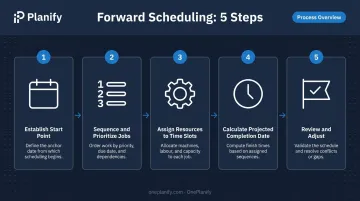
Step 5 — Review and Adjust
Compare the projected completion date against any delivery commitments. If there's a conflict, you have options:
- Reprioritize other jobs to free up capacity
- Add resources or split batches to compress the timeline
- Flag the order for customer renegotiation
This review step surfaces a real limitation: forward scheduling tells you when work will finish, but it doesn't guarantee that finish date meets your commitments. That gap requires active management.
A Simple Manufacturing Example
Those five steps translate directly to the shop floor. Consider a metal fabrication shop that receives three work orders on Monday morning.
Using forward scheduling:
- Work Order A loads on Machine 1 at 7:00 AM
- Work Order B starts when A finishes at 11:30 AM
- Work Order C loads at 2:00 PM after a scheduled setup
By end of day Monday, the shop knows all three orders will complete by Wednesday afternoon. The planner now has an honest lead time to communicate to the customer — no guessing, no overpromising.
Forward Scheduling vs. Backward Scheduling
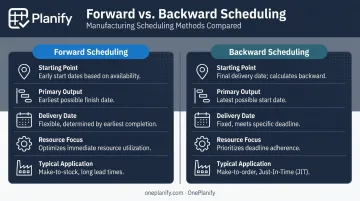
The two approaches solve opposite problems. Backward scheduling starts from a fixed delivery due date and works backward through each production stage to determine when work must begin, answering: "What is the latest we can start and still deliver on time?"
The key difference: forward scheduling produces a completion date as its output; backward scheduling produces a required start date. Both preserve the same physical sequence of operations.
| Factor | Forward Scheduling | Backward Scheduling |
|---|---|---|
| Starting point | Earliest available date | Fixed delivery due date |
| Primary output | Projected completion date | Required start date |
| Delivery date | Flexible — emerges from schedule | Fixed — drives the schedule |
| Resource focus | Maximize utilization | Meet deadline with minimal waste |
| Inventory impact | Higher — goods may finish early | Lower — timed to arrival need |
| Typical application | Make-to-stock, high-volume | Make-to-order, custom/deadline work |
When each method fits best:
- Forward scheduling suits continuous, high-volume production where throughput and utilization are the priority
- Backward scheduling suits custom or deadline-driven orders where inventory holding costs and exact ship dates matter most
Modern scheduling tools can apply both methods within the same operation, switching based on order type — so most operations benefit from applying both.
Benefits and Challenges of Forward Scheduling
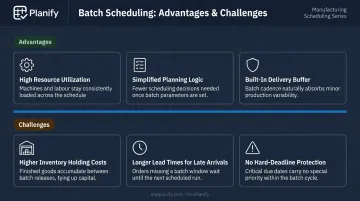
Advantages
High resource utilization Jobs fill the next available slot immediately. Machines and labor stay productive rather than sitting idle while the schedule waits for a future target date to approach.
Simplified planning logic The schedule moves chronologically forward, which is intuitive to build, explain, and communicate to the shop floor. There's less mental effort compared to reverse-engineering timelines from a due date.
Built-in delivery buffer Finishing production ahead of a delivery deadline creates room to absorb last-minute disruptions — a machine breakdown, an absent operator, a quality hold — without automatically missing the customer promise.
Challenges
These advantages come with real tradeoffs. Here's where forward scheduling can create friction:
Higher inventory holding costs Finished goods may sit in storage well before they're needed, tying up capital and warehouse space. McKinsey research on manufacturer-to-retailer delivery penalties illustrates how timing mismatches in the supply chain carry real financial consequences — early delivery can be penalized just as late delivery can.
Longer lead times for late arrivals When a new urgent order arrives and the schedule is already fully loaded, it joins the back of the queue. Without intervention, it may miss customer expectations entirely.
No hard-deadline protection Forward scheduling doesn't automatically flag when a projected completion will miss a committed ship date. The planner must cross-check manually — which is manageable at low order volumes but becomes error-prone as complexity grows.
Best Practices for Forward Scheduling in Manufacturing
Define a Job Prioritization Policy First
Before scheduling a single job, define the rules: safety-critical first, then by customer tier or order due date, for example. Without a clear policy, lower-priority jobs can occupy capacity that urgent orders need. Research comparing 30+ priority rules for job shop scheduling confirms there's no universal best rule — the right policy depends on your objectives, whether that's minimizing tardiness, reducing lead times, or maximizing throughput.
Use Realistic Task Durations
Build schedules using durations that reflect what actually happens on your floor: setup times, machine changeovers, shift transitions, and buffer for known variability. Schedules built on optimistic cycle times become unreliable within hours of release.
Treat the Schedule as a Living Document
New urgent jobs, equipment breakdowns, absent operators, and material shortages all disrupt a forward schedule. A static plan built Monday morning is often outdated by Tuesday noon on a busy shop floor.
Research on rescheduling policies identifies three approaches: periodic (update on a fixed cadence), event-driven (update when disruptions occur), and hybrid (combine both).
The balance matters: excessive rescheduling creates nervousness on the floor, while following an obsolete plan erodes on-time performance. For most shops, daily updates combined with event-driven adjustments for major disruptions strikes the right balance.
Consider a Purpose-Built Finite Scheduling Tool
Manual forward scheduling works for small, simple operations. As order volume and complexity grow, a dedicated finite scheduling solution becomes essential.
Tools like OnePlanify are built specifically for this complexity. The platform handles:
- Setup times and machine changeovers
- Shift changes and operator availability
- Job dependencies across work centers
- Real-time disruptions without manual rework
The interface is designed to be as easy to use as a spreadsheet — giving planners who've outgrown manual methods a capable tool without the overhead of an enterprise system. OnePlanify is currently in private beta; you can request access at oneplanify.com.
Frequently Asked Questions
What is forward scheduling and how does it differ from backward scheduling?
Forward scheduling starts from the earliest available date and calculates when work will finish. Backward scheduling starts from a due date and calculates when work must begin. Forward scheduling suits flexible-deadline or make-to-stock environments; backward scheduling suits fixed-deadline commitments where hitting a specific ship date is non-negotiable.
What is an example of forward scheduling?
A machine shop receives three work orders Monday morning, assigns each to the next available machine in sequence, and determines by end of day that all orders will complete by Wednesday. The planner now has an honest lead time to share with the customer — no reverse-engineering required.
What are the three types of scheduling?
The three common types are:
- Forward scheduling — schedule from the earliest start date to find the completion date
- Backward scheduling — schedule from the due date backward to find the required start date
- Mixed/hybrid scheduling — combine both methods based on order type or priority within the same operation
What are the main advantages of forward scheduling in manufacturing?
Three advantages stand out:
- High resource utilization — jobs fill available slots immediately rather than waiting for a target date
- Simplified planning logic — sequencing moves chronologically forward, reducing complexity
- Built-in buffer time — the gap between production completion and delivery absorbs last-minute disruptions
When should I switch from forward to backward scheduling?
Backward scheduling is the better choice when a customer order has a firm, non-negotiable delivery date, when minimizing finished-goods inventory is a priority, or when the production environment is primarily make-to-order or engineer-to-order where each job has unique timing requirements.