
Introduction
Most manufacturers don't lose production time because machines fail. They lose it because work orders arrive at the shop floor missing parts, lacking clear scope, or scheduled into capacity that simply doesn't exist. The crew shows up, finds the job isn't executable, and the day unravels from there.
The financial stakes are real. According to a 2024 Siemens study, manufacturing downtime can cost SMEs as much as $150,000 per hour at the top end — a figure that makes even modest improvements in planning and scheduling worth serious attention.
This guide covers the full work order lifecycle: from planning (making work executable) through scheduling (putting the right work on the right machine at the right time). The focus is the manufacturing shop floor, not generic maintenance theory.
Here's what this guide delivers:
- A framework for building "ready-to-schedule" work orders before they hit the floor
- A weekly scheduling process that accounts for setups, shift changes, and job dependencies
- The key metrics to measure and track improvement over time
Key Takeaways
- Planning and scheduling are separate functions with different owners — conflating them keeps teams reactive
- Work orders aren't ready to schedule until scope, materials, labor estimates, and safety requirements are all confirmed
- Finite scheduling produces more reliable plans than infinite scheduling, especially on complex shop floors
- Schedule compliance and planned-vs-reactive ratio are the two metrics that reveal whether the process is working
Work Order Planning vs. Scheduling: Why the Distinction Matters
Most manufacturing teams treat planning and scheduling as one job. That's the root cause of most shop floor chaos.
Planning answers what needs to be done and how. The planner identifies parts, writes job steps, confirms permits, estimates labor hours, and verifies that a technician can walk out and execute the job without delays or guesswork. The planner's output is a fully prepared work order.
Scheduling answers when and who. The scheduler assigns fully planned work orders to the right machine, crew, or work center during an available production window — accounting for capacity, setup time, shift boundaries, and job dependencies. The scheduler's output is a realistic weekly or daily plan.
What Happens When You Conflate Them
When one person does both, neither gets done well. Planners spend their time reacting to scheduling gaps instead of preparing work. Schedulers build plans around work orders that aren't truly ready — and then watch technicians return mid-job for missing parts or unclear instructions.
The Four Roles and Their Accountability
Separating the problem from the solution requires defining who owns each function — even if that's not four different people:
| Role | Primary Accountability |
|---|---|
| Planner | Preparing fully executable work orders before they enter the schedule |
| Scheduler | Matching ready work to available capacity in a realistic weekly plan |
| Supervisor | Executing the daily plan and managing crew-level adjustments |
| Technician | Completing jobs as planned and providing post-job feedback |
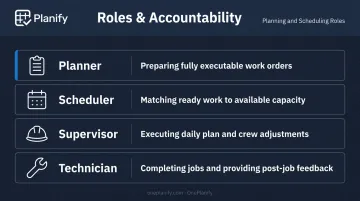
These don't have to be four separate people — especially in smaller shops — but the functions must stay distinct. When preparation and planning share the same to-do list, both suffer.
The Work Order Planning Process: What "Ready-to-Schedule" Really Means
"Ready-to-schedule" is a gating standard, not a courtesy label. A work order only enters the scheduling queue when all planning inputs are confirmed.
This prevents the most common scheduling failure: putting half-prepared jobs on the schedule and watching technicians return to the shop mid-job for missing parts, permits they didn't know about, or scope they can't interpret.
The Five Elements of a Well-Planned Work Order
1. Scope and craft requirement
Define exactly what the job involves, what "done" looks like, and which skill set or work center is needed. Vague scope leads to scope creep, wrong crew assignments, and rework. If a technician can't read the work order and know precisely what they're executing, it's not ready.
2. Job steps and safety requirements
Break the job into a logical sequence of steps, and lock in lockout/tagout procedures, required PPE, and permits — hot work, confined space — before the job starts. Safety requirements discovered on-site stop jobs cold.
3. Parts and materials confirmed and staged
All materials should be identified, ordered, and kitted before the job enters the schedule. Technician time evaporates when parts hunting happens during execution rather than before it. A complete kit at the job site beats an hour of reactive scrambling every time.
4. Labor and duration estimates
Realistic hour estimates are the foundation of a buildable schedule. They don't need to be perfect — grounded in past actuals and technician input is enough. Unrealistic estimates make every downstream schedule unreliable. A job estimated at two hours that consistently takes four will eventually collapse the weekly plan.
5. Feedback loop
Post-job technician notes — actual vs. estimated hours, missing materials, unclear steps — are the primary source for improving future plans. This creates a cycle that tightens estimates and updates SOPs over time. Without it, planning stays static and the same problems repeat.
A work order missing any of these five elements isn't ready to schedule — and putting it on the board anyway just moves the disruption downstream to the shop floor.
Work Order Scheduling on the Shop Floor: Building a Realistic Weekly Plan
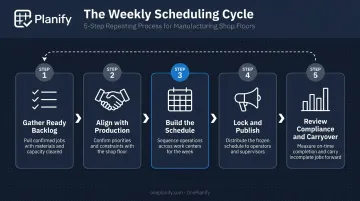
The Weekly Scheduling Cycle
The weekly cycle keeps manufacturing work controlled and predictable. It runs in five steps:
- Gather the ready backlog — pull all work orders that have passed the "ready-to-schedule" gate
- Align with production — confirm priorities and available downtime windows with operations leadership
- Build the schedule — match workload to available labor and machine capacity
- Lock and publish — communicate the plan to supervisors and crews
- Review compliance and carryover — at week's end, assess what completed, what carried, and why
Finite vs. Infinite Scheduling
Most ERP systems schedule with infinite capacity — meaning they produce plans that ignore whether machines are actually available, how long setups take, or where shift boundaries fall. The plan looks complete on paper and fails on the floor.
Finite scheduling works differently. It accounts for real machine availability, setup times between jobs, crew shift boundaries, and job sequencing dependencies — so the plan reflects what can actually be executed. OnePlanify's Planify platform applies this approach directly: planners work in a familiar spreadsheet-like interface while the system enforces finite capacity constraints behind the scenes.
Internal data from OnePlanify illustrates why this matters: a schedule that looks 85% utilized on paper often runs at only 60% in reality — a 25-percentage-point gap driven almost entirely by unmodeled setup and changeover time.
That utilization gap points to a deeper question: how much should you actually load the schedule? Doc Palmer's maintenance planning methodology offers a practical answer.
The "Schedule to 100%, Target 80% Completion" Principle
The right approach is to:
- Load the schedule to 100% of forecast available labor — this provides structure and forces realistic capacity planning
- Target approximately 80% weekly completion as a healthy outcome — accounting for natural variability like minor breakdowns, carryover, or emergency work
- Investigate compliance above 90% — this often signals the schedule wasn't fully loaded, not that the team is exceptional
Scheduling to 60-70% of capacity under-utilizes the crew. Scheduling to 110% produces constant missed commitments and erodes trust in the plan.
Scheduling Complexity Specific to Manufacturing
General scheduling tools don't handle what shop floors actually face:
- Sequence-dependent setups — the order jobs run on a machine affects total setup time. Job A → Job B may take 45 minutes; Job A → Job C may take 15. Ignoring this destroys utilization accuracy.
- Shift change handoffs — partially completed jobs must be handed off cleanly. A job that starts on first shift and finishes on second needs continuity, not confusion.
- Multi-operation routing — a single production order may touch five work centers in sequence. A delay at step two ripples through steps three through five automatically.
- Disruption handling — when a machine goes down mid-week, the schedule must be rebuilt around real remaining capacity. Planify replans around the disruption quickly, keeping setup sequences, shift boundaries, and job dependencies intact rather than starting from scratch.
Protecting the Schedule Once Published
Publish the weekly plan and defend it. Establish a clear policy: only true production-stopping emergencies justify changes once the week begins. Mid-week changes driven by preference rather than necessity are the fastest way to destroy technician trust in the plan and push crews back into constant reprioritization.
Planify handles this through its "Pretend mode" — planners model disruption impact before committing any change to the live schedule, which introduces a structured review step rather than impulsive ad hoc replanning.
How to Prioritize Work Orders in a Manufacturing Environment
Without a structured priority framework, schedulers make ad hoc decisions under pressure. The loudest request gets the slot. Critical planned maintenance gets pushed to "next week" indefinitely.
A Four-Level Priority Framework
| Priority | Definition | Response Target |
|---|---|---|
| P1 — Emergency | Safety risk or total production stoppage | Execute same shift |
| P2 — Urgent | Significant production impact within 24 hours | Execute within 24 hours |
| P3 — Planned | Degradation or scheduled PM | Current week |
| P4 — Deferred | Low-impact work batched into planned windows | Next available window |
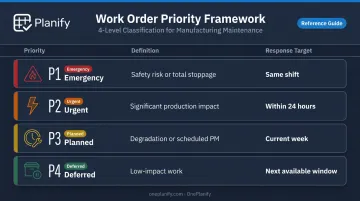
The framework only works if it's applied consistently. When priority decisions are made ad hoc, the framework becomes meaningless within weeks.
Asset Criticality as the Foundation
Not all equipment failures carry the same consequence. A bottleneck machine that feeds three downstream work centers should always rank higher than a parallel machine with available backup capacity.
Build a criticality matrix for your key assets, rating each on production impact, backup availability, and safety consequence. Use those scores to drive automatic priority assignment. Without that anchor, priority frameworks drift toward whoever argues loudest.
Managing the Backlog
A healthy backlog of two to four weeks of planned, ready work is a sign of a functioning program, not a sign of falling behind. It means the scheduling team has options and isn't constantly scrambling to fill the week with half-prepared jobs.
The target ratio to work toward: roughly 80% of maintenance labor hours on planned work, 20% or less on reactive work. Plants that implement structured planning consistently shift this ratio within a few months, because preparing work in advance eliminates the reactive scrambles that consume so much capacity.
Metrics That Show Whether Your Planning and Scheduling Is Working
Three metrics reveal the health of the system. Track all three — they tell different parts of the story.
Schedule Compliance Rate
Definition: Percentage of work orders completed in the week they were scheduled.
Low compliance — below 70% — almost always indicates unready work entering the schedule, not a technician performance problem. If the jobs were truly ready and the schedule was realistically loaded, completion rates follow.
Per Doc Palmer's methodology, a schedule loaded to 100% of forecast capacity should achieve approximately 80% completion as a healthy baseline. Compliance consistently above 90% may indicate the schedule wasn't fully loaded in the first place.
Planned vs. Unplanned Work Ratio
This ratio tracks what percentage of total labor hours go toward planned work versus reactive emergency work — and it's probably the clearest single signal of whether a program is controlled or just keeping up.
A target of roughly 80% planned work is widely cited as a healthy benchmark. Most plants moving from unstructured to structured planning see this ratio improve within the first few months, because preparing work ahead of time cuts the reactive scrambles that consume disproportionate labor hours.
Wrench Time (Productive Time)
Definition: Percentage of a technician's time actually spent on productive work versus waiting, traveling, hunting for parts, or seeking clarification.
Doc Palmer's foundational planning methodology benchmarks wrench time at approximately 35% before strong planning and scheduling practices are in place, rising to around 55% afterward — a measurable productivity gain without adding headcount.
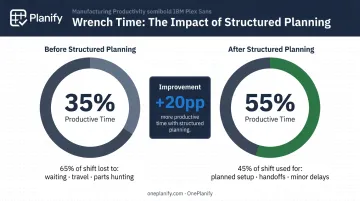
Strong planning directly drives this improvement. When technicians arrive at the job with a clear scope, kitted materials, and confirmed permits, they execute. Without that preparation, the first hour often disappears before a wrench is picked up.
Frequently Asked Questions
What is work order planning and scheduling?
Work order planning is the preparation phase : defining scope, confirming materials, estimating labor, and documenting safety requirements so a job is fully executable. Scheduling is the assignment phase — matching those ready work orders to available capacity, crew, and production windows.
What is a work order in planning?
In the planning context, a work order is a structured document that defines a specific task's scope, required materials, job steps, labor estimates, and safety requirements. It's the planner's output — one that must be fully complete before the work order enters the scheduling queue.
What elements should be considered when planning a work order?
Five elements must be confirmed: clearly defined scope and craft requirement, step-by-step job instructions with safety notes, confirmed and staged parts and materials, realistic labor and duration estimates, and documented permit requirements. All five must be complete for a work order to be considered "ready-to-schedule."
What is the difference between finite and infinite scheduling in manufacturing?
Finite scheduling accounts for actual machine capacity, setup times, shift boundaries, and job dependencies so the plan reflects what can realistically be executed. Infinite scheduling (common in ERP tools) ignores these constraints, producing plans that look complete on paper but routinely fail on the shop floor.
How do you prioritize work orders on the shop floor?
Use a four-level framework — Emergency, Urgent, Planned, Deferred — anchored to asset criticality. Bottleneck machines and safety-critical equipment always rank higher than assets with available backup. This eliminates ad hoc priority decisions made under pressure.
What metrics should manufacturers track for work order scheduling effectiveness?
Three metrics matter most:
- Schedule compliance rate: percentage of scheduled work completed on time
- Planned vs. unplanned work ratio: target roughly 80% planned
- Wrench time: percentage of technician time spent on productive work
Together, these reveal where the planning and scheduling process is holding — and where it's leaking.