
The operational appeal is real: less inventory, lower carrying costs, better responsiveness to customer demand. But JIT scheduling also introduces a tension that manufacturers often underestimate. The same dynamic sequencing that reduces warehouse overhead places considerable pressure on shop floor workers — unpredictable overtime, last-minute changeovers, and schedules that shift without warning.
This article covers what JIT scheduling actually means in a manufacturing context, how it affects the people doing the work, the operational risks it creates, and the practices that help manufacturers execute it without eroding their workforce.
Key Takeaways
- JIT scheduling sequences work orders by delivery due date, not batch size or machine availability
- Schedule instability directly drives absenteeism, lateness, and turnover — all measurable and preventable
- Unplanned downtime costs industrial businesses roughly $125,000 per hour — machine reliability isn't optional in a JIT environment
- Finite scheduling tools that account for real constraints outperform manual and MRP-based approaches
- Workers with schedule visibility and input into the process show better attendance and lower quit rates
What Is Just-in-Time Scheduling in Manufacturing?
JIT scheduling is a specific form of production scheduling where work order sequencing is driven by delivery due dates and product priorities — not machine availability or convenient batch sizes. The goal is to complete each order as close to its due date as possible, holding minimal inventory at every stage.
The Core Scheduling Logic
In practice, schedulers sort work orders by two dimensions:
- Due date (ascending) — the primary sort; the earliest deadline goes first
- Secondary priority factor — when due dates coincide, a tiebreaker like shelf life, customer criticality, or regulatory potency decay determines the sequence
A simplified example: a food manufacturer with six work orders due across three days would first rank them by delivery date, then within the same day, sort by perishability — putting the item with the shortest viable shelf life first.
What sounds straightforward on paper becomes genuinely complex when you're managing hundreds of overlapping work orders, variable run times, multi-machine dependencies, changeover constraints, and rotating shift patterns simultaneously.
JIT scheduling is most critical in:
- Food and beverage — freshness windows are non-negotiable
- Pharmaceuticals and radiopharmaceuticals — potency can decay within hours or days
- Automotive — lean inventory and parts synchronization across supply chains
JIT Scheduling vs. Traditional Fixed Scheduling
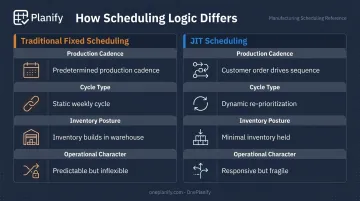
Traditional manufacturing scheduling follows a predetermined production cadence — you run Product A on Mondays, Product B on Tuesdays, regardless of whether actual customer demand aligns with that rhythm. It's predictable, but it generates inventory that may sit in a warehouse for weeks.
JIT scheduling inverts this. The customer order drives the sequence, and work orders are continuously re-prioritized as demand signals change — creating a dynamic schedule rather than a static one. That responsiveness delivers efficiency gains, but it also introduces operational fragility when demand shifts faster than the schedule can adapt.
The shift from spreadsheets and paper-based scheduling toward software-driven sequencing has made tighter JIT execution possible — but it has also transferred the burden of constant adjustment onto schedulers and supervisors who must respond to deviations in near real time. According to a 2024 Manufacturing Leadership Council survey, 70% of manufacturers still collect or enter data manually — a gap that makes accurate, real-time JIT execution harder than it should be.
How JIT Scheduling Affects Employees on the Shop Floor
The efficiency logic of JIT makes sense from a supply chain perspective. From an hourly worker's perspective, it can feel like controlled chaos.
The Variable Cost Problem
In JIT environments, workers are functionally treated as a flexible resource — one that can be scaled up or down based on production demand. On the shop floor, this translates to:
- Last-minute overtime requests when a high-priority order needs to ship
- Early dismissals when demand drops, reducing take-home pay for hourly employees
- Setup and changeover assignments that arrive the same day they need to happen
- Forced idle time between work order sequences
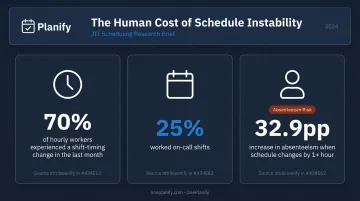
Research from The Shift Project at Harvard Kennedy School found that among hourly workers, 70% experienced a shift-timing change in the last month and 25% worked on-call shifts — patterns that map directly onto JIT shop floor dynamics.
Specific Worker Pain Points
The effects show up in workers' daily lives:
- Makes childcare and second-job coordination nearly impossible when shift times are fluid
- Compounds physical fatigue when overtime arrives without pattern or warning
- Raises mental stress when workers don't know production pace targets until they clock in
- Erodes ownership when the schedule feels generated by software rather than communicated by a manager
The business consequences follow. A 2023 Harvard Business School study analyzing more than 28 million shift-level timecards found that scheduling a worker with a start time differing by more than one hour from their prior week increased lateness probability by 21.3 percentage points and absenteeism by 32.9 percentage points. That's not a marginal effect — it's a structural one.
The Turnover Math
High absenteeism is costly. High turnover is worse. Recent BLS JOLTS data shows manufacturing separation rates at 2.2% monthly, with 529,000 job openings outstanding. Replacing a frontline worker costs roughly 40% of their annual salary, according to Gallup estimates — and manufacturers are already competing for a shrinking talent pool.
A 2024 Deloitte survey found that 47% of manufacturers identified flexible work arrangements — including shift swapping and predictable scheduling — as their most impactful retention lever. That finding sits directly in tension with traditional JIT scheduling execution, where flexibility flows one direction: toward the production floor, not toward the worker.
The data points to a specific gap: JIT philosophy optimizes material flow, but most implementations leave worker schedule stability as an afterthought. Closing that gap is where best practices begin.
Common Risks and Challenges of JIT Scheduling
JIT's efficiency comes from eliminating buffers. That's also where it breaks down — there's nothing to absorb a shock when something goes wrong.
Operational Disruption Points
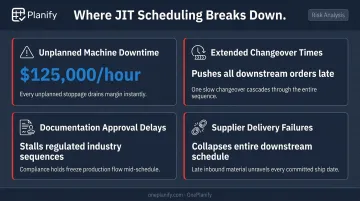
The primary failure modes in JIT scheduling:
- Unplanned machine downtime — ABB's 2023 Value of Reliability survey found unplanned outages cost the typical industrial business about $125,000 per hour
- Extended changeover times — setup sequences that run longer than planned push every subsequent work order later
- Documentation approval delays — in regulated industries, waiting on batch records or quality sign-offs can stall an entire sequence
- Supplier delivery failures — JIT assumes reliable inbound material; when it doesn't arrive on time, the entire downstream schedule collapses
The Supply Chain Dependency Risk
The automotive semiconductor shortage demonstrated this fragility at scale. JIT practices had minimized inventory across the supply chain, leaving manufacturers with almost no buffer when chip supply tightened. McKinsey estimated that scarcity caused billions in lost automotive revenue — and AlixPartners forecast the global auto industry lost $210 billion in 2021 alone as a direct result.
The Human-Algorithm Gap
There's also a softer failure mode that doesn't make headlines: when schedulers accept software-generated sequences without accounting for worker availability, skill levels, or shift constraints. The resulting schedule may be mathematically optimal and operationally unworkable.
A machine operator who called in sick, a setup technician not trained on a specific line, a sequence that requires a crew size the current shift can't support — these gaps between algorithmic output and shop floor reality are a leading cause of JIT execution failures that never show up in system logs.
Best Practices for Implementing JIT Scheduling Effectively
Use Finite Scheduling Software That Respects Real Constraints
The fundamental problem with most scheduling tools in JIT environments is that they treat capacity as unlimited. MRP and ERP systems generate sequences without accounting for actual machine availability, operator shift constraints, or setup time dependencies, producing schedules that look clean on screen and break down on the floor.
Finite scheduling tools solve this by incorporating real constraints into the sequence from the start. Tools like OnePlanify are built specifically for this gap: designed to handle setups, shift changes, job dependencies, and disruptions in a single scheduling environment, without the configuration complexity of traditional APS systems.
The positioning is direct. Comprehensive finite scheduling as easy to use as a spreadsheet, built for the messy reality of the shop floor rather than an idealized model of it.
For manufacturers running JIT, the difference between finite and infinite scheduling isn't academic. One produces a schedule your crew can actually execute; the other begins falling apart at the first shift change.
Build Advance Notice Into the Process
The data on schedule notice is unambiguous. The Harvard Business School study cited earlier shows that even small variations in start time — more than one hour from the prior week — produce significant jumps in absenteeism and lateness. Predictive scheduling laws in jurisdictions like Chicago, Berkeley, and Evanston require covered manufacturing employers to provide 14 days' advance notice of work schedules, with predictability pay for changes made within that window.
Even where those laws don't apply, publishing work order sequences and shift assignments 48–72 hours ahead reduces worker stress, improves attendance, and gives supervisors time to address conflicts before they become absences. Front-line managers who make employee-aware adjustments to software-generated schedules report better team cohesion than those who simply post the algorithmic output unchanged.
Implement Total Productive Maintenance
Unplanned downtime is the most direct cause of JIT schedule collapse. McKinsey research found that predictive maintenance programs typically reduce machine downtime by 30% to 50% and extend machine life by 20% to 40%. NIST data supports this: manufacturers implementing improved maintenance practices reported 35% to 45% reductions in downtime and 65% to 95% reductions in defects.
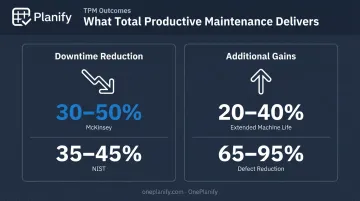
TPM protects schedule adherence by eliminating the most common trigger for cascade failures — the kind JIT environments have little margin to absorb.
Monitor Schedule Adherence at the Work Order Level
Tracking the gap between planned and actual production durations (at the individual work order level, not just the shift or day level) allows schedulers to identify which activities consistently cause delays. Common culprits include:
- Setup time that routinely exceeds estimates
- A specific machine with recurring micro-stoppages
- A downstream approval step that adds hours to the queue
Without this granularity, schedule problems get addressed reactively. With it, targeted process redesign or training can resolve root causes before they compound into missed delivery dates.
Engage Workers as Partners, Not Variables
Manufacturers who build feedback loops between shop floor workers and the scheduling process, letting workers flag realistic constraints, availability changes, and skill preferences, see measurably better schedule compliance. Workers who have some agency over their schedules are less likely to call in sick, less likely to quit, and more likely to flag a problem before it becomes a missed shipment.
This doesn't require complex systems. It requires a practice: a channel for workers to raise concerns, and managers who act on what they hear. That responsiveness shows up directly in attendance data.
Frequently Asked Questions
What is just-in-time scheduling?
Just-in-time scheduling sequences and times work orders so goods complete as close as possible to their delivery due date. The goal is to minimize inventory accumulation and waste by responding directly to customer demand rather than running on a fixed production cycle.
What is an example of just-in-time scheduling?
A food producer with six work orders due across three days would sort them by delivery date first, then by perishability when due dates coincide, producing the most time-sensitive items earliest. This ensures nothing expires in storage and every shipment hits its window.
How does just-in-time scheduling affect employees?
JIT scheduling can create unpredictable overtime demands, last-minute shift changes, and income instability for hourly workers. Manufacturers using transparent, employee-aware scheduling tools and practices — including advance notice and worker feedback channels — can significantly reduce these negative effects.
What are the biggest risks of just-in-time scheduling in manufacturing?
The primary risks are unplanned machine downtime, extended changeover times, supplier delivery failures, and the absence of inventory buffers to absorb any of these disruptions. Any single failure can ripple through the entire schedule when there's no safety stock to compensate.
How is JIT scheduling different from traditional manufacturing scheduling?
Traditional scheduling follows fixed production cycles regardless of demand timing. JIT scheduling dynamically re-sequences work orders based on due dates and customer priorities, requiring more sophisticated tools and real-time visibility to execute reliably, especially as order volumes scale.
What tools help manufacturers implement JIT scheduling successfully?
Finite scheduling and Advanced Planning and Scheduling (APS) systems that account for real constraints — machine availability, operator shifts, setup sequences, and changeover times — provide the most reliable foundation. Tools that treat capacity as unlimited consistently produce schedules that break down on the actual shop floor.