
Introduction
Most production planners know the feeling: a stack of work orders, a whiteboard or spreadsheet, and a floor full of machines competing for the same jobs. The schedule that looked solid Monday morning is already unraveling by Tuesday afternoon.
This isn't just a workflow inconvenience. According to Modern Machine Shop's Top Shops benchmarking data, high-performing machine shops maintain average order lead times of 20 days compared to 25 days at other shops — a 20% difference that compounds across every customer delivery and every capacity decision made throughout the year.
Job shop scheduling sits at the intersection of daily manufacturing decisions and one of the hardest optimization problems in computer science. Most production managers are solving it manually, and the gap between a well-optimized schedule and a good-enough one shows up directly in delivery performance, machine utilization, and planner burnout.
This guide is written for production planners, shop floor managers, and manufacturing operations leads who want to move beyond gut-feel scheduling.
It covers what job shop scheduling actually is, why it's hard to optimize, which methods exist to solve it, and what modern finite scheduling tools can realistically do on a live shop floor.
Key Takeaways
- Job shop scheduling (JSSP) assigns and sequences work orders across shared machines to meet objectives like minimizing makespan, delays, or cost
- The JSSP is NP-hard — possible sequences grow factorially, making manual optimization unreliable as job counts increase
- Real shop floors add setup times, shift changes, machine breakdowns, and last-minute order changes on top of that complexity
- The right scheduling objective (makespan, OTIF, cost) depends on your business priorities — there's no universal answer
- Finite scheduling tools enforce real-world constraints automatically, producing feasible schedules that spreadsheets can't reliably deliver
What Is Job Shop Scheduling?
Job shop scheduling is the process of deciding which work orders run on which machines, in what sequence, and at what time — given that each machine can only process one job at a time and most jobs require multiple operations across multiple machines in a fixed order.
The Core Structure
Picture a custom metal part that needs cutting first, then drilling, then grinding — each on a different machine. That's one job. Now add 15 more jobs with different routings, different processing times, and different due dates. Formally, the problem works like this:
- n jobs must be processed across m machines
- Each job has a set of operations that must complete in order (precedence constraints)
- Each operation requires a specific machine for a specific duration
- Machines cannot multitask
Why It Becomes Exponentially Hard
The number of valid job sequences grows factorially with job count. Cornell's optimization library describes the search space in terms of n! feasible orderings — and that number escalates fast:
| Jobs | Possible Sequences |
|---|---|
| 4 | 24 |
| 10 | 3,628,800 |
| 15 | 1,307,674,368,000 |
| 20 | 2,432,902,008,176,640,000 |
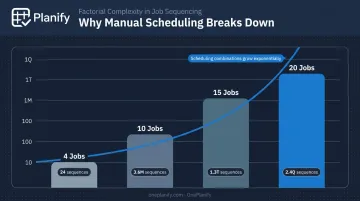
Garey, Johnson, and Sethi demonstrated in 1976 that the m-machine job shop shortest-schedule problem is NP-complete for m ≥ 2. Brute-forcing an optimal schedule isn't feasible once job count moves past a handful — this isn't a practical limitation, it's a mathematical one.
Job Shop vs. Other Shop Types
What distinguishes a job shop from simpler production models is routing flexibility. In a job shop, different jobs can follow entirely different machine routes. One order might go lathe → mill → inspect; another might skip the lathe entirely and start at grinding.
That's what enables high-mix production — and what makes scheduling significantly harder than in flow-line environments where every part follows the same path.
Why Is Job Shop Scheduling So Hard to Optimize?
The sequence explosion is only part of the problem. Real shop floors violate nearly every assumption the academic model makes.
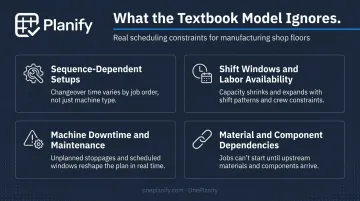
Real-World Constraints the Textbook Ignores
Cornell's JSSP documentation notes that basic models often exclude uncertain factors like equipment malfunction and worker absence. The practical layer on top of the combinatorial complexity includes:
- Sequence-dependent setup times — changing from one product type to another requires cleaning, retooling, or calibration, and how long that takes depends on what ran before. A setup matrix where every job-to-job transition has a different time is hard to optimize without algorithmic help.
- Shift windows and labor availability : a job started near shift end may sit idle for hours before the next operator picks it up, but static schedules rarely account for this
- Machine downtime and maintenance — a breakdown mid-shift doesn't just delay one job; it cascades across everything waiting on that machine
- Material and component dependencies — a downstream operation can't start until an upstream one finishes, and sometimes the parts haven't even arrived yet
The Handbook of Production Scheduling notes that roughly 30% of the data needed to bridge scheduling theory and practice — including human factors — isn't easily computerized.
These constraints alone make scheduling difficult. Layer in competing objectives, and the problem compounds further.
Competing Objectives Make It Harder
There's no single "best" schedule — it depends on what you're optimizing for. A sequence optimized to finish all jobs as fast as possible might require expensive back-to-back setups. A sequence that minimizes setup costs might push a high-priority order past its due date. Planners are constantly navigating these trade-offs, often with no reliable way to evaluate them.
Dynamic Disruptions Break Static Schedules
Even a well-built schedule can unravel within hours. A rush order arrives. A machine goes down. A supplier delivers late. The problem isn't only building a good schedule once — it's maintaining one as conditions shift throughout the day.
This is the core reason manual scheduling fails at scale. When disruptions hit, rebuilding a sequence from scratch takes time most shops don't have — so planners patch the schedule locally instead of re-optimizing it globally.
Job Shop Scheduling Objectives: What Are You Optimizing For?
Before selecting a scheduling method or tool, define what "optimal" means for your operation. The same set of jobs can produce very different schedules depending on the objective.
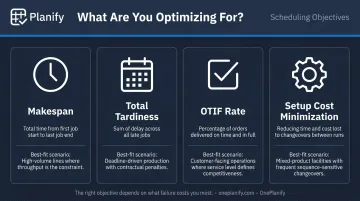
Common Scheduling Objectives
| Objective | Definition | Best Suited For |
|---|---|---|
| Makespan | Total time to complete all jobs | Maximizing throughput and machine utilization |
| Total tardiness | Sum of delays past due dates | Operations with contractual delivery commitments |
| OTIF rate | % of orders delivered on time and in full | Suppliers to retailers or customers with penalties |
| Setup cost minimization | Minimizing changeover time and cost | High-mix operations with long or expensive setups |
Objectives Can Conflict
A purely makespan-optimized schedule sequences jobs to minimize idle time, which may require constant machine-to-machine switching and high setup costs. Meanwhile, grouping similar jobs to minimize setups may delay certain orders past their due dates.
The right approach comes down to what failure costs you most. If you supply a retailer with vendor penalty clauses (Walmart, for example, fined suppliers 3% of cost of goods sold for missing OTIF requirements), delivery performance takes priority. In high-volume commodity manufacturing, cost minimization often wins instead.
Multi-Objective Scheduling
Because these trade-offs rarely disappear entirely, more advanced scheduling systems can optimize for two or more objectives at once — minimizing tardiness while keeping setup time under a set limit, for example. Pick your primary objective based on what hurts most when it goes wrong, then use constraints to protect secondary goals.
Algorithms and Methods for Solving Job Shop Scheduling Problems
Solving JSSP comes down to a trade-off between solution quality and computational speed. Exact methods guarantee the best possible answer but struggle with scale. Heuristic methods find good answers fast without guaranteeing they're perfect.
Exact Methods
Branch and Bound is the most established exact method. It builds a decision tree of possible job sequences, pruning branches that can't improve on the best solution found so far. For small problems — fewer than 10 jobs on a single machine — it can find the true optimum. But computational cost grows rapidly. This approach works well in academic benchmarking on small, clean instances. It doesn't scale to a live shop running 50 work orders.
Heuristic and Priority Dispatching Rules
These are the simplest practical approach. Common rules include:
- Shortest Processing Time (SPT) — always run the quickest job next; minimizes average flow time
- Earliest Due Date (EDD) — prioritize the job with the nearest deadline; minimizes maximum lateness
- Critical Ratio — compares time remaining until due date versus remaining processing time; prioritizes jobs at risk of lateness
Their appeal: simple, fast, no software required, and easy to explain to anyone on the floor. Their limitation is that they're locally greedy. Each decision looks good in isolation, but the cumulative result is rarely globally optimal.
Meta-Heuristic Methods
Meta-heuristics find near-optimal solutions for large, real-world instances without guaranteeing perfection. Three approaches dominate JSSP literature:
- Genetic Algorithms — evolve a population of candidate schedules through selection, crossover, and mutation, mimicking natural evolution. Wang et al. evaluated a hybrid genetic algorithm across 43 standard benchmark instances, including classic test cases like FT06 and LA series problems.
- Simulated Annealing — explores the solution space by occasionally accepting a worse solution to escape local optima, similar to how metal cools and settles into a stable structure
- Tabu Search — tracks recently visited solutions to prevent cycling and force exploration of new regions of the search space
The right choice depends on the problem. Tabu Search tends to perform well on standard JSSP benchmarks; Genetic Algorithms handle multi-objective problems effectively; Simulated Annealing is flexible and relatively simple to implement.
For most shop floor planners, none of this requires hands-on knowledge of the math. Modern finite scheduling software embeds one or more of these engines inside its core — planners interact with a visual schedule board, and the optimization runs in the background.
Job Shop vs. Flow Shop vs. Open Shop: Key Differences
Choosing the right scheduling approach starts with correctly identifying your production model.
| Model | Routing structure | Scheduling complexity |
|---|---|---|
| Job Shop | Each job has its own machine sequence | High — routing variety creates combinatorial explosion |
| Flow Shop | All jobs follow the same machine sequence | Lower — Johnson's algorithm solves the 2-machine case optimally |
| Open Shop | Operations have no required order | Different — scheduler controls both timing and operation sequence |
Johnson's 1954 algorithm provides an optimal solution for two-machine flow shops. Garey et al. showed that flow shop scheduling becomes NP-complete at three or more machines — and job shop scheduling reaches NP-completeness at just two.
Misidentifying your shop type leads to applying the wrong scheduling logic. A planner treating a high-mix job shop like a flow shop will build schedules that ignore routing variation and produce misleading completion time estimates.
Flexible Job Shops
Many real facilities don't fit neatly into any of these three models. A flexible job shop — where each operation can be processed on any machine within a group of similar machines — adds routing flexibility and scheduling complexity. This is common in CNC machining environments where multiple identical machines can handle the same operation.
How to Improve Job Shop Scheduling on Your Shop Floor
Theory is useful. Getting better results on Monday morning requires a practical path forward.
Start with an Honest Audit
Before adopting any new approach, understand your current state:
- How are schedules built today — spreadsheet, ERP module, whiteboard, or planner memory?
- How often is the schedule revised when disruptions occur?
- Where does idle time or late delivery most commonly originate?
- What's your current on-time delivery rate and average lead time?
These baselines matter. Modern Machine Shop's Top Shops benchmark shows a 5-day lead time advantage for high-performing shops (20 days vs. 25 days) — but you can't close a gap you haven't measured.
Make the Shift to Finite Scheduling
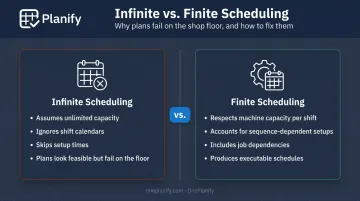
Most ERP systems default to infinite capacity planning: they assume your machines can always absorb more work, ignoring shift calendars, setup times, and concurrent job loads. The resulting plan looks feasible on paper but falls apart on the floor.
Finite scheduling works differently. It respects actual constraints:
- Machine capacity per shift
- Sequence-dependent setup times
- Job dependencies and material availability
- Maintenance windows and downtime
As TheFabricator explains, finite capacity scheduling blocks out operation time — including setup, run, and teardown — and calculates realistic start and stop times on constrained resources. That's the gap between a plan that looks good in the system and a schedule your floor can execute.
Use the Right Tool for the Job
Closing that gap requires software built for constraint modeling, not bolted-on ERP modules. OnePlanify is one example: a cloud-based finite scheduling platform built for the realities of shop floor operations, including setups, shift changes, job dependencies, and real-time disruptions.
What sets it apart from generic planning tools is usability. The goal is finite scheduling as easy to navigate as a spreadsheet, so planners spend their time managing exceptions rather than rebuilding sequences from scratch. OnePlanify is currently in private beta with small-batch team onboarding. Manufacturers interested in early access can request a spot at oneplanify.com.
Frequently Asked Questions
What is job shop scheduling?
Job shop scheduling is the process of assigning and sequencing work orders across shared machines, where each job may follow a unique routing and each machine handles one job at a time. The goal is to meet defined objectives — minimizing delays, reducing total completion time, or maximizing on-time delivery.
What's the biggest challenge in job shop scheduling?
The core challenge is combinatorial complexity — valid job sequences grow factorially with job and machine count, making exhaustive manual optimization impossible at realistic shop scales. Real-world factors like sequence-dependent setups, machine breakdowns, and dynamic order changes add further complexity.
What is the difference between job shop and flow shop scheduling?
In a flow shop, all jobs follow the same machine sequence — every part goes through the same steps in the same order. In a job shop, different jobs follow entirely different machine routes. That routing flexibility makes job shop scheduling significantly harder and rules out the simpler algorithms that work well for flow shops.
What algorithms are used to solve job shop scheduling problems?
Three main categories apply: exact methods like Branch and Bound (provably optimal, but limited to small problems); priority dispatching rules like SPT and EDD (fast but not globally optimal); and meta-heuristics like Genetic Algorithms, Simulated Annealing, and Tabu Search. Meta-heuristics are the practical choice for larger, real-world instances.
How does finite scheduling differ from infinite scheduling?
Infinite scheduling (common in ERP systems) assumes unlimited machine capacity and ignores constraints like shift calendars, setup times, and concurrent job loads. Finite scheduling respects all of these, producing a schedule that reflects what can actually happen on the floor.
Can scheduling software handle real-time shop floor disruptions?
Modern finite scheduling tools are designed for rapid rescheduling when disruptions occur — machine breakdowns, rush orders, or material shortages. Rather than rebuilding a schedule from scratch, planners can generate a revised, feasible schedule quickly, keeping the floor moving with minimal manual intervention.