This post covers what production scheduling actually is, why poor scheduling costs manufacturers more than most realize, how the process works step by step, and what separates a scheduling approach that holds up under disruption from one that leaves teams in permanent firefighting mode.
Key Takeaways
- Production scheduling organizes and sequences manufacturing tasks to make the best use of machines, labor, and materials while meeting customer demand on time
- Poor scheduling compounds waste at every stage: idle machines, missed deliveries, excess WIP, and unplanned expediting costs
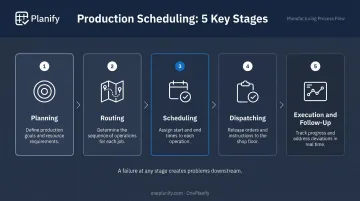
- The five core stages are planning, routing, scheduling, dispatching, and execution — each feeds directly into the next
- Finite capacity scheduling accounts for real constraints — shift patterns, setup times, machine availability — making it the most practical method for complex shop floors
What Is Scheduling in Production?
Production scheduling is the process of determining what needs to be manufactured, in what order, on which machines or workstations, by which workers, and by when — all while staying within the actual limits of available capacity.
A production schedule is more than a list of jobs. It's an operational blueprint that captures every production order with timing, resource assignments, sequencing logic, and lead times. What separates it from a simple to-do list is what it accounts for:
- Dependencies between operations (Op 10 must finish before Op 20 can start)
- Machine changeover and setup times between jobs
- Shift boundaries and calendar exceptions
- Material availability windows
- The downstream effects of any single delay
That last point is worth sitting with. A one-hour slip in the morning doesn't stay a one-hour slip — it ripples through every job queued behind it.
The schedule also connects business functions that would otherwise operate in silos. Sales uses it to set realistic delivery commitments. Procurement uses it to time material arrivals. Managers use it to spot bottlenecks before they halt output, not after.
What Does a Production Scheduler Do?
The production scheduler translates production plans and customer orders into a detailed, sequenced, resource-assigned schedule, then monitors execution in real time and updates the plan whenever disruptions hit.
That second part is where the role gets demanding. Machine breakdowns, material delays, and rush orders don't pause to wait for a clean solution. A scheduler has to make fast trade-off decisions under pressure:
- Which job slips to protect a more critical delivery
- Which customer needs a call before they figure it out themselves
- Which workaround keeps the floor moving without creating a bigger problem downstream
The role demands deep operational knowledge and clear thinking under pressure — often at the same time.
Why Production Scheduling Matters: The Real Cost of Getting It Wrong
Resource Utilization
Without a schedule, machines sit idle while workers wait for materials, or workers stand around while machines queue jobs in the wrong order. NIST estimates that unplanned downtime accounts for 8.3% of planned production time across U.S. discrete manufacturing, representing a massive pool of capacity that simply disappears.
That's not an abstract number. It's production that was paid for and never delivered.
On-Time Delivery
Scheduling failures cascade. One delayed job pushes back an entire production run, which triggers late deliveries, penalty clauses, and the kind of damaged customer relationships that don't fully repair themselves. When the schedule is built on realistic capacity assumptions, delivery commitments hold. When it isn't, late shipments stop being exceptions and start being expected.
Inventory and Waste
Poor scheduling forces manufacturers toward one of two bad outcomes:
- Overproduction — excess work-in-progress tying up capital, consuming floor space, and masking real throughput problems
- Underproduction — stockouts that trigger emergency expediting, premium freight costs, and production disruptions at the customer's end
A well-structured schedule aligns output tightly with demand signals, reducing both extremes.
The Financial Case
Those inventory swings have a direct financial counterpart. Poor scheduling shows up across multiple line items at once:
- Overtime paid to recover from delays that a better schedule would have prevented
- Expediting costs to fast-track materials that should have been planned in advance
- Scrap from rushed or mis-sequenced production runs
- Lost equipment utilization from changeovers that weren't sequenced intelligently
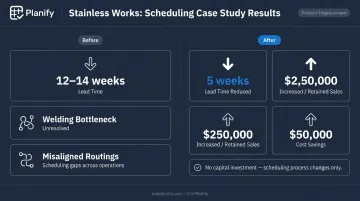
A concrete illustration: one Ohio manufacturer, Stainless Works, reduced lead time from 12–14 weeks to 5 weeks after correcting routings, identifying a welding bottleneck, and applying forward scheduling to that constrained department. Stainless Works reported $250,000 in increased or retained sales and $50,000 in cost savings, all from scheduling process changes rather than capital investment in new equipment.
Complexity Is the Default
Setups and changeovers, shift changes, sequence-dependent jobs, and unplanned disruptions aren't edge cases. They're the daily operating environment. Production scheduling matters precisely because it gives the floor a framework for absorbing that complexity without everything grinding to a halt. Without one, a single machine breakdown or late material delivery triggers a cascade that takes days to untangle — when it could have been a 20-minute replan.
The Five Stages of Production Scheduling
Production scheduling is a sequential process, not a single action. Each stage feeds into the next, and a failure at any stage creates problems downstream. While terminology varies across organizations, the five stages below represent the standard workflow.
Planning
Planning is where managers analyze customer demand, available capacity, raw material supply, workforce availability, and budget constraints to set overall production targets.
The critical distinction here is between static planning — which assumes conditions stay fixed — and dynamic planning, which builds in flexibility for change. In real manufacturing environments, static planning breaks down quickly. Demand shifts, suppliers miss windows, machines fail mid-run. Dynamic planning treats those events as expected inputs, not exceptions that break the model.
Routing
Routing maps the exact path materials and work orders will take through the facility — which workstations they'll visit, in what order, and what operations will be performed at each step.
The goal is efficiency: minimize travel time, reduce unnecessary setup changes, and identify potential bottlenecks before they appear on the floor. Poor routing decisions rarely announce themselves directly; they surface later as missed deadlines and overloaded work centers.
Scheduling
Using the routing as input, schedulers assign specific start and end times to each operation, accounting for machine availability, shift patterns, and job priorities. This stage produces three common schedule types:
- Master schedule — the full production picture across all resources
- Operations/manufacturing schedule — routing-level detail for each work center
- Retail operations scheduling — finished goods through to distribution
Dispatching
Dispatching is when the schedule moves from plan to floor. Workers receive job assignments, work orders, material releases, and instructions. It's the bridge between the timetable and actual execution — and it's where the quality of the upstream schedule becomes visible. A well-dispatched schedule gives every operator a clear answer to "what do I do next and with what?"
Execution and Follow-Up
Production begins, and managers monitor progress against the schedule in real time. This stage involves:
- Tracking work-in-progress at each workstation
- Identifying deviations from the planned sequence
- Resolving bottlenecks as they surface
- Making fast scheduling adjustments when reality diverges from the plan
- Conducting quality checks at defined operation points
Reality always diverges from the plan to some degree. What separates well-run shops from struggling ones is detection speed — catching a deviation at hour two costs far less than catching it at end of shift.
Common Production Scheduling Methods
Forward vs. Backward Scheduling
These are the two foundational scheduling directions, and the choice between them shapes how risk is distributed across the production timeline.
Forward scheduling starts from the earliest available date and sequences jobs forward. It maximizes resource utilization and gives the floor maximum run time — but it can create backlog risk if jobs accumulate faster than capacity clears them.
Backward scheduling works from the customer's due date back to the present. It prioritizes delivery performance and makes due-date commitments more reliable — but it compresses the buffer available to absorb disruptions, leaving less margin for error.
Many manufacturers use both, depending on job priority and customer commitment type.
Finite vs. Infinite Capacity Scheduling
How a scheduling system treats capacity constraints determines whether the resulting plan is executable or fictional.
| Finite Capacity | Infinite Capacity | |
|---|---|---|
| Respects resource limits? | Yes — machine hours, shifts, setup times | No — can double-book the same resource |
| Output | A plan the floor can actually execute | A plan that looks feasible in the system |
| Best use | Day-to-day shop floor scheduling | High-level long-range planning |
For manufacturers managing complex environments — multiple shifts, sequence-dependent setups, multi-operation routings — finite scheduling is the only realistic day-to-day approach. OnePlanify's Planify platform is built around this method, treating setup times, shift calendars, routing dependencies, and machine availability as hard constraints rather than assumptions.
Make-to-Order vs. Make-to-Stock
These aren't just production strategies — they're scheduling orientations.
- Make-to-order (MTO) triggers production only when a customer order arrives, minimizing inventory risk but demanding fast, accurate scheduling to hit committed delivery dates
- Make-to-stock (MTS) produces to a forecast, optimizing throughput and lead time at the cost of inventory exposure
Many manufacturers blend both, and the scheduling method must align with whichever model is active for a given product line.
Production Scheduling vs. Production Planning: What's the Difference?
These terms are often used interchangeably, but they operate at different levels and answer different questions.
| Dimension | Production Planning | Production Scheduling |
|---|---|---|
| Time horizon | Weeks to months | Days, shifts, or hours |
| Core question | What to make, and how much? | When, in what order, on which machine? |
| Level of detail | Aggregate quantities and capacity | Specific jobs, operations, and timing |
| Update frequency | Periodic | Frequently — sometimes in real time |
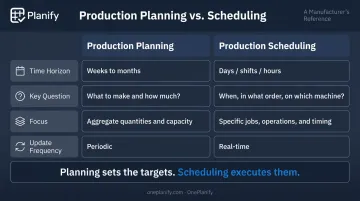
Production planning sets the targets and constraints the scheduler works within. Scheduling is the execution mechanism that converts those targets into floor-level assignments.
The relationship is hierarchical: a strong plan with weak scheduling produces missed deadlines. A detailed schedule built on a flawed plan produces efficient execution of the wrong priorities. Getting one right without the other still leaves production exposed.
What to Look for in a Production Scheduling Solution
Why Spreadsheets Fall Short
Spreadsheets are the default scheduling tool on most shop floors — and they work until they don't. NIST has noted that spreadsheet-based operational analysis requires resources and expertise that many small and mid-sized manufacturers simply lack, and that reliance on manual processes can embed costs into operations before they're even visible.
In practice, spreadsheets have hard limits that compound quickly:
- Can't model setup times or job dependencies — a schedule ignoring changeover time might show 85% utilization on paper while running at 60% in reality
- Don't reflect real-time disruptions, so a machine breakdown or rush order requires manual rework from scratch
- Create version-control problems the moment two people are editing the same file
Core Capabilities to Require
Any scheduling solution worth deploying should handle:
- Finite capacity modeling that respects machines, shifts, setup times, and routing dependencies as hard constraints
- Real-time replanning when disruptions occur — machine breakdowns and rush orders can't wait for hours of manual rework
- Clear job sequencing visibility so managers can see workload across every resource without hunting through multiple files
- ERP integration that pulls live work orders and pushes dispatched sequences back to the floor
- Usability that non-specialists can adopt — a tool that requires a dedicated APS expert to operate will either be used poorly or not used at all
Few tools satisfy all five. OnePlanify's Planify platform addresses each one: it models sequence-dependent setup times, per-work-center shift calendars, multi-operation routing dependencies, and disruption replanning. It runs in a browser with a spreadsheet-familiar interface, so planners typically reach full adoption within weeks of onboarding.
Practical Evaluation Questions
Before selecting a tool, get direct answers to these:
- How quickly does the system generate a new schedule after a disruption?
- Does it surface conflicts and bottlenecks before they reach the floor?
- Can it integrate with your existing ERP without a six-month IT project?
- Will the planners who use it daily find it intuitive enough to adopt fully?
The last question gets skipped most often and carries the most weight. A scheduling tool that planners work around is just expensive overhead.
Frequently Asked Questions
What does production scheduling mean?
Production scheduling is the process of organizing, sequencing, and timing manufacturing tasks to make the best use of available machines, labor, and materials while meeting production goals and customer delivery commitments. It converts production plans into specific, time-bound, resource-assigned instructions for the shop floor.
What do production schedulers do?
Production schedulers translate production plans and customer orders into detailed, resource-assigned schedules, then monitor execution in real time. When disruptions hit — machine breakdowns, material delays, rush orders — they update the schedule, make trade-off decisions, and keep the floor running as close to plan as possible.
What is the difference between production planning and production scheduling?
Production planning is the higher-level, medium-to-long-term process of determining what to produce and in what volumes. Production scheduling is the short-term, operational process of determining when, in what order, and on which resources each job runs. In short: planning answers "what and how much"; scheduling answers "when and on what."
What is finite capacity scheduling?
Finite capacity scheduling builds the production schedule around actual, real-world resource constraints — machine hours, shift availability, setup times — rather than assuming unlimited capacity. When a resource is unavailable, the job is scheduled later. This makes it the most realistic method for day-to-day shop floor scheduling.
What happens when production scheduling breaks down?
Scheduling failures typically trigger missed delivery deadlines, idle machines and workers, excess work-in-progress inventory, emergency expediting costs, and strained customer relationships. A single failure rarely stays contained — it cascades through every job behind it in the queue.