Introduction
Most shop floors have more jobs queued than machines available. The order you run them in — which job goes first, which waits — shapes throughput, setup time, and whether deliveries land on time or don't. That decision is work sequencing, and it's one of the most consequential calls a production planner makes every shift.
This guide is written for production planners, scheduling leads, and operations managers who deal with this daily. When sequencing works, throughput improves, setups shrink, and orders ship on time. When it breaks down — or gets skipped — the floor runs reactively, WIP piles up between stations, and late orders become routine.
What follows covers the rules and logic behind work sequencing, what makes it difficult in real shop conditions, and how to apply it effectively.
Key Takeaways
- Work sequencing determines which job runs next at each work center — directly affecting delivery performance, setup waste, and WIP levels
- Core sequencing rules include EDD, SPT, Minimum Setup Time, and Critical Ratio — each targets a different performance objective
- No single rule is universally optimal; the right choice depends on shop floor conditions and business priorities
- Setups, shift boundaries, machine dependencies, and unplanned disruptions make manual sequencing difficult to sustain at scale
- Finite scheduling tools can automate sequencing while preserving planner override capability
What Is Work Sequencing?
Work sequencing is the operational decision that determines the order in which queued jobs are released to and processed through work centers. It's distinct from broader production scheduling, which assigns start and finish times across a planning horizon and allocates specific resources to each job.
Good sequencing: minimize wasted time between jobs (setup, idle, wait), improve on-time delivery, and keep work flowing predictably through the floor.
The terminology distinction matters:
- Scheduling answers: when does this job run, and on which machine?
- Sequencing answers: among the jobs already queued at this work center, which one runs next?
Sequencing is a decision within scheduling, but it's one of the most impactful daily choices made at the work center level. Even a well-built master schedule unravels when individual stations sequence poorly — jobs pile up, setups compound, and due dates slip before anyone notices.
Why Work Sequencing Matters on the Manufacturing Shop Floor
Manufacturing shop floors create sequencing pressure that office-based planning rarely anticipates. Multiple work centers run simultaneously, each with its own queue. Setup times vary depending on which job ran before the current one. Delivery deadlines are fixed. And an inefficient sequence at one station creates congestion at every downstream station.
Without deliberate sequencing, several things typically go wrong:
- Excessive setup time from poorly ordered color, material, or tooling changes — time that produces nothing
- Ballooning WIP between stations as jobs pile up waiting for the next available machine
- Chronic late deliveries because urgency wasn't factored into queue order
- Unplanned replanning that pulls schedulers away from proactive decisions and destabilizes the entire queue
The cost of poor scheduling discipline is real. Deloitte estimates that poor maintenance and unplanned downtime can reduce productive capacity by 5% to 20%. While that figure covers equipment maintenance broadly, it illustrates the scale of capacity loss that compounds when shop floor management — including sequencing — is undisciplined.
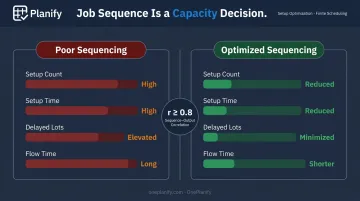
Research from a manufacturing simulation study found that setup count, setup time, delayed lots, and average flow time are tightly correlated (r ≥ 0.8). Improving the order in which jobs run directly reduces the time machines spend in changeover rather than production. In practice, job sequence is a capacity decision: change the order, and you change how much of your scheduled hours convert to finished output.
How Work Sequencing Works on a Shop Floor
The Core Logic
At any given moment, a work center has a queue of jobs competing for capacity. The sequencing decision is simple to state: which job from that queue runs next? The answer is governed by sequencing rules — also called priority rules or dispatching rules.
Each rule optimizes for a specific objective. None is universally best.
The Four Primary Sequencing Rules
| Rule | Logic | What It Optimizes |
|---|---|---|
| Earliest Due Date (EDD) | Run the job with the soonest due date first | Minimizes maximum lateness across the queue |
| Shortest Processing Time (SPT) | Run the quickest job first | Minimizes average flow time and reduces WIP |
| Minimum Setup Time | Run the job requiring the least changeover from the current setup | Maximizes productive machine time |
| Critical Ratio (CR) | Run the job with the lowest ratio of time remaining to work remaining | Balances urgency against remaining workload |
Research on dispatching rules confirms that SPT produces the lowest average production lead time in multi-stage systems, while EDD minimizes maximum tardiness under standard single-machine conditions. The right choice comes down to what the floor is optimizing for at any given moment.
Blending Rules in Practice
Pure rules applied rigidly often underperform blended approaches. A common and effective combination: sort by due date first, then apply setup optimization as a secondary sort within date windows. This means jobs with similar due dates get reordered to minimize changeover time between them, capturing delivery performance and setup efficiency at once.
The right blend shifts as floor conditions shift. High changeover costs make setup grouping more attractive; a surge in late orders swings priority back toward EDD. Effective planners treat sequencing rules as instruments, not fixed policies.
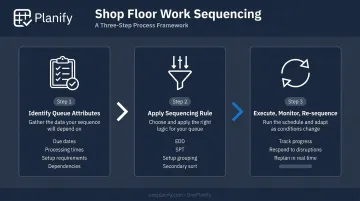
The Three-Step Sequencing Process
Identify jobs in queue and their attributes — Gather due dates, processing times, setup requirements relative to the current job, and downstream dependencies. This data is the foundation for every sequencing decision. Without it, planners are guessing.
Apply the appropriate rule or combination — Select the rule that matches current priorities. Apply it, then use a secondary sort where setup relationships or urgency warrant it. Document the logic so the sequence can be explained and defended when priorities get challenged.
Execute, monitor, and re-sequence as conditions change — Release jobs in order, then track actual progress against the plan. Disruptions — machine downtime, material shortages, rush orders — will require mid-shift re-sequencing. Finite scheduling software like OnePlanify can replan the full board in seconds when disruptions hit, preserving setup, shift, and dependency constraints without starting from scratch manually.
Key Factors That Affect Work Sequencing in Manufacturing
Several interdependent factors make real-world sequencing more complex than the textbook version.
Sequence-Dependent Setup Times
Setup time is not fixed: it depends on which job ran immediately before. A color change from light to dark takes less time than dark to light. A tooling swap between similar parts takes minutes; between dissimilar ones, it can take hours. Peer-reviewed research on injection molding and food production models this explicitly: changeover duration is determined by the transition between specific job pairs, not a generic average.
The order of jobs directly determines total productive capacity. Two shops with identical work content can produce dramatically different output depending on how intelligently they sequence changeovers.
OnePlanify models exact sequence-dependent setup times using a changeover matrix (Job A → Job B carries a different setup cost than Job A → Job C) and groups compatible jobs to minimize re-tooling across the shift.
Job Mix and Routing Complexity
In job shops or mixed-mode environments, jobs follow different routes through work centers. Sequencing at Station 1 affects queue buildup at Stations 2 and 3. A planner who optimizes one station without visibility into downstream impact can inadvertently starve or flood the next operation.
Shift Boundaries and Labor Availability
A job that starts near the end of a shift may not finish before the crew changes. Partial completions create handoff risks: quality issues, lost setup state, or rework from miscommunication between shifts. Sequences must account for how much work can realistically complete within a shift window, not just what's theoretically next in the queue.
Demand Priority and Delivery Commitments
Customer-facing due dates, contractual penalties, and high-value order status sometimes override pure efficiency logic. A planner may need to jump a specific order to the front of the queue regardless of what the sequencing rule recommends. This manual intervention is legitimate: the goal is informed override, not arbitrary disruption.
Real-Time Disruptions
Any unplanned event can invalidate a previously optimized sequence. Common disruption triggers include:
- Machine breakdowns mid-run
- Material delays or quality holds
- Unplanned rework that reinserts jobs into the queue
- Rush orders that displace committed work
Manufacturing rescheduling research identifies these as triggers requiring periodic, event-driven, or hybrid rescheduling responses. How fast a shop can re-sequence after a disruption has as much impact on daily output as the original plan.
Common Misconceptions About Work Sequencing
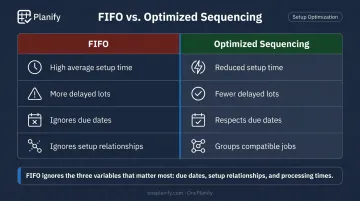
FIFO Is Not a Sequencing Strategy
First-in, first-out feels fair and operationally simple. It's also one of the worst-performing approaches in most manufacturing environments. A 2018 manufacturing simulation found that high-priority FIFO produced comparatively high average setup time and more delayed lots. The same study showed that reducing FIFO's priority in favor of setup-oriented sequencing improved setup, WIP, and flow-time measures simultaneously. FIFO ignores the three variables that matter most to shop floor performance: due dates, setup relationships, and processing times.
Sequencing Is Not a One-Time Daily Decision
Treating sequencing as something done once at shift start and then left alone is a failure mode. The floor changes constantly — jobs finish faster or slower than estimated, machines go down, materials arrive late. An optimized morning sequence can be obsolete by 10 AM. Effective sequencing responds to real conditions throughout the shift, not just at the start of it.
Sequencing Doesn't Create Capacity
Better sequencing recovers capacity that was being wasted on excessive setups, idle time, and disorganized queue management. But if a shop is chronically overloaded, improved sequencing increases efficiency without resolving the fundamental shortfall. The fix for a capacity problem is capacity planning, not sequence optimization. Diagnosing which problem you actually have — throughput ceiling vs. poor queue order — determines which lever is worth pulling.
When Sequencing Is the Wrong Focus
Sequencing optimization yields diminishing returns in specific environments:
- Highly automated single-product lines with no setup variability
- Shops with very low job mix diversity where queue order barely matters
- Operations where the binding constraint is upstream material availability, not work center queue management
If material never arrives on time, optimizing the queue sequence doesn't help. Before investing effort in sequencing refinement, identify whether sequencing is actually the binding constraint — or whether the real issue is capacity planning, unrealistic delivery commitments, or staffing gaps.
Conclusion
Work sequencing is the daily operational decision that determines the order jobs run at each work center. Applied with awareness of setup relationships, due dates, and real floor conditions, good sequencing directly recovers productive capacity and improves delivery performance without adding resources.
No single rule works in every situation. The real skill is understanding the tradeoffs each rule makes and applying sound judgment to real-world shop floor complexity. Used intelligently — often in combination — these rules give planners a structured way to make consequential decisions quickly:
- EDD protects delivery commitments by prioritizing due dates
- SPT moves material faster by clearing short jobs first
- Setup grouping preserves machine time by reducing changeover frequency
- Critical Ratio catches at-risk jobs before they go late
OnePlanify supports that judgment by automating the computational side of sequencing: modeling setup dependencies, enforcing shift constraints, and replanning the full board in seconds when disruptions hit — while keeping planners in control of every change.
Frequently Asked Questions
What is job sequencing?
Job sequencing is the process of determining the order in which jobs are processed at a work center or machine. It's governed by priority rules — such as Earliest Due Date or Shortest Processing Time — that optimize for specific goals like on-time delivery, setup efficiency, or throughput.
What are examples of sequencing in manufacturing?
A powder coating line sequencing jobs by color family (lights before darks) to reduce changeover time is a classic setup-based example. A machine shop sorting its queue by earliest due date to minimize late deliveries is an EDD-based example.
What is the difference between job sequencing and production scheduling?
Scheduling assigns jobs to specific machines and time slots across a planning horizon. Sequencing determines the order jobs run within a single work center queue. The two are nested: sequencing is a decision embedded within the broader scheduling plan.
What is the most commonly used sequencing rule in manufacturing?
Earliest Due Date (EDD) is widely used because it directly targets on-time delivery performance. In high-changeover environments — press shops, coating lines, CNC operations — Minimum Setup Time sequencing is often preferred to protect productive capacity from excessive changeover waste.
How does setup time affect job sequencing decisions?
When setup times are sequence-dependent, changeover duration varies based on which job ran immediately before. Grouping similar jobs — same color family, compatible tooling, matching material grades — reduces total setup time per shift and recovers capacity that would otherwise be lost to re-tooling.
Can work sequencing be automated?
Yes. Finite scheduling software can automate sequencing by applying priority rules and optimization logic across all work center queues simultaneously. Planners retain the ability to manually override decisions where shop floor knowledge adds value — the best tools combine automated optimization with deliberate human control.